
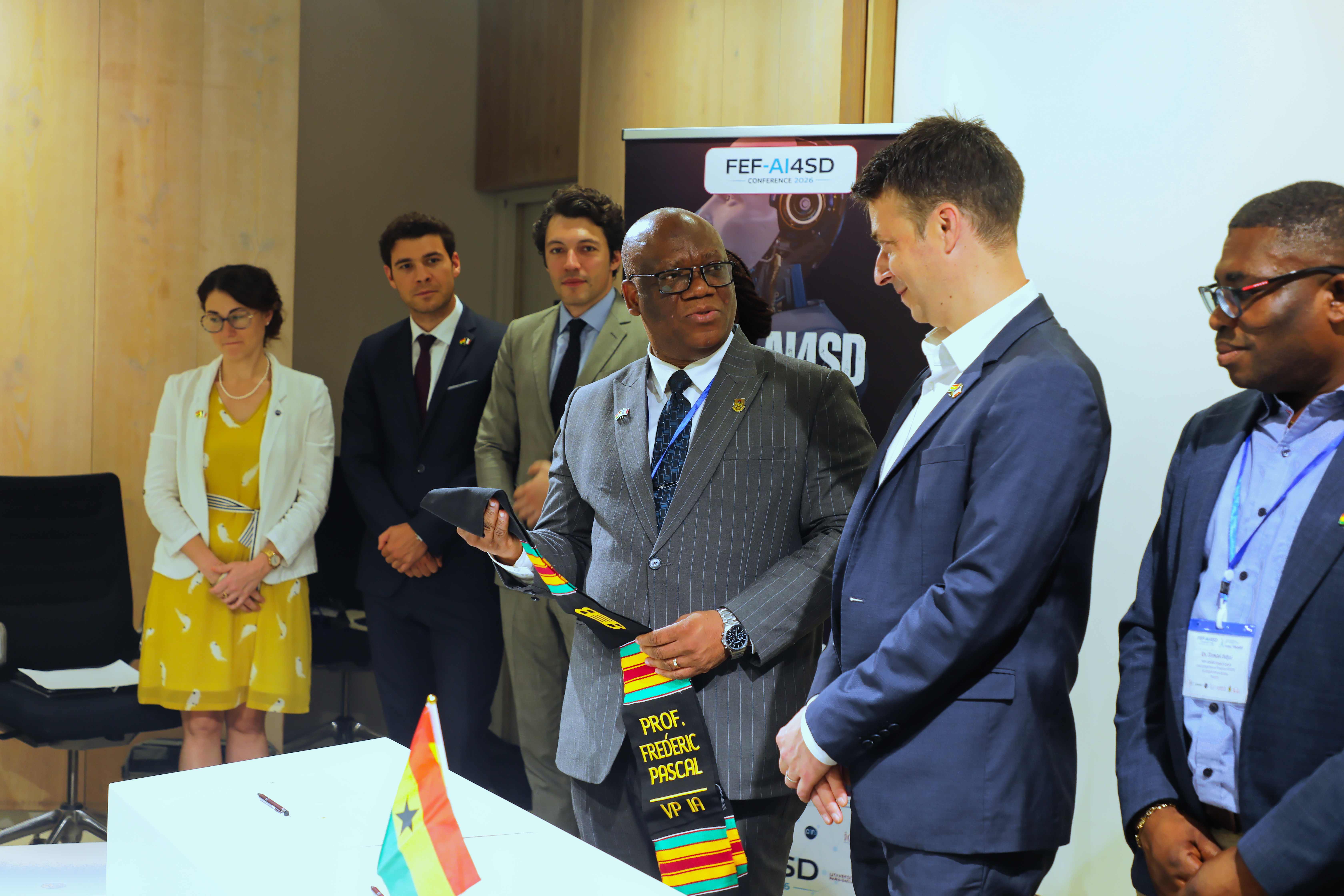
The Responsible Artificial Intelligence Lab (RAIL) at the Kwame Nkrumah University of Science and Technology (KNUST) and DATAIA at Université Paris-Saclay (UPS) have signed a Memorandum of Understanding (MoU) to strengthen collaboration in artificial intelligence (AI), marking a key milestone at the Artificial Intelligence for Sustainable Development (AI4SD) Conference in Paris.
The agreement establishes a framework for cooperation in data science and artificial intelligence, responsible and ethical AI, undergraduate and postgraduate education, joint research and innovation, student and staff exchanges, joint supervision of students, intellectual property development, science communication and societal impact, with a focus on Africa and Europe.
The MoU was signed by Ghana's Ambassador to France, H.E. Mavis Ama Frimpong; Director of the DATAIA Institute and Vice President of Université Paris-Saclay, Prof. Frédéric Pascal; and Project Lead for the AI4SD Project at KNUST and Principal Investigator and Scientific Director of RAIL, Prof. Jerry John Kponyo.
The signing took place during the AI4SD Conference, which brought together researchers, policymakers, industry leaders and development partners from Ghana, France and other countries to explore how artificial intelligence can drive sustainable development.
Addressing participants, Ambassador Mavis Ama Frimpong said Ghana is positioning itself as a leader in Africa's emerging AI ecosystem through investments in homegrown innovation and strategic international partnerships.
"We are gathered here today at a pivotal moment in history where technology drives the key parameters of development. Ghana is no longer just adopting technology but actively building an indigenous ecosystem of innovation needed to support the pace of our development," she said.
She described Ghana's AI ecosystem as "not an imitation of a foreign framework but a vibrant homegrown movement driven by the brilliant minds of young people, researchers and entrepreneurs."
The Ambassador said the country's technological transformation is being driven under the leadership of President John Dramani Mahama and anchored by the Ghana AI Strategy, adding that artificial intelligence is central to accelerating progress towards the Sustainable Development Goals (SDGs).
She also commended RAIL at KNUST for developing ethical, context-appropriate AI solutions tailored to African challenges.
Prof. Jerry John Kponyo said the conference provided an opportunity to reflect on the achievements of the AI4SD project while charting a path for its long-term sustainability through stronger international partnerships.
He said the recently launched Ghana AI Strategy opens a new phase of collaboration, with priority areas including agriculture, health, education, startups and innovation, and disability inclusion.
"I dream of French companies collaborating with Ghanaian companies to create wealth together, students collaborating across borders to solve industry problems, and researchers collaborating to solve global challenges," he said.
Prof. Kponyo said RAIL's work is anchored on four pillars: research and development, capacity building, policy influence and stakeholder engagement. He also highlighted the Lab's contributions to the UNESCO Readiness Assessment Methodology (RAM) and the development of Ghana's AI Strategy.
Prof. Frédéric Pascal, Vice President of Université Paris-Saclay and Director of the DATAIA Institute, described the agreement as the beginning of a long-term scientific partnership between the French and Ghanaian AI ecosystems.
"I am delighted to see that this preparation between the Ghanaian and French ecosystems has reached this new milestone. We have begun a long-term scientific relationship. At DATAIA, we believe that only through bilateral cooperation can AI models be developed," he said.
He described Ghana as one of Africa's leading AI ecosystems and reaffirmed Université Paris-Saclay's commitment to the Africa Forward Initiative.
Prof. Pascal said the partnership extends beyond academic research to fostering innovation and economic impact through collaboration between universities, researchers and industry.
"We are moving beyond academic research and training to a model of an integrated cluster capable of creating direct economic impact in innovation on both sides. Today, we celebrate the signing of a strategic MoU with RAIL KNUST," he said.
Representing France's Ministry for Europe and Foreign Affairs, Mr. Thomas Dumont said France remains committed to supporting partnerships that harness AI for sustainable development.
"We understand that AI is becoming a chief driver of development and growth. Beyond the financial contribution of the FEF-AI4SD programme, it provides the framework for projects that deliver solutions for healthcare and agriculture. We are pleased to have supported this initiative, and we thank all those who made it possible," he said.
The conference also featured remarks from Prof. Guillaume Van Der Rest, Director of the Institut de Chimie Physique; Ms. Clarisse Munier of the Centre National de la Recherche Scientifique (CNRS); Ms. Fiona Gerente, Head of International Partnerships at Université Paris-Saclay; Mr. Alexandre Mirlesse, AI Special Envoy of the French President for the Africa Forward Summit; and Dr. Daniel Adjei, FEF-AI4SD Project Lead at the Institut de Chimie Physique, who outlined the conference programme and acknowledged the contributions of the steering committee and partner institutions.


